Harvard Economist Dr. Raj Chetty Delivers “Convening for Opportunity” Keynote on Confronting Economic Disparities in Colorado
Dr. Chetty Spoke with Business Leaders on Inequalities that Exist in Workforce, Small Business Ownership and Housing Data During a Denver Metro Chamber of Commerce, Bank of America and Prosper CO Virtual Event
DENVER (March 3, 2021) – The Denver Metro Chamber of Commerce, Bank of America and Prosper CO convened local business leaders for a discussion on economic disparities in Colorado. Raj Chetty, Ph.D., William A. Ackman professor of public economics at Harvard University, delivered a presentation on insights the business community can gather from his research to increase equity and opportunity for their employees. Ebony Thomas, senior vice president of racial equality for Bank of America, Raju Patel, Denver market president for Bank of America, and Kelly Brough, president and CEO of the Denver Metro Chamber of Commerce, also spoke at the event.
Today’s event, “Convening for Opportunity: Confronting Economic Disparities” coincided with the release of Prosper CO’s Top 10, a list of action items and steps employers and employees can take to increase opportunity within their organizations. Prosper CO is an affiliate of the Denver Metro Chamber, launched in 2019 that brings together the public, private and nonprofit sectors to identify, understand and eliminate the barriers to economic opportunity in Colorado, particularly for Black, Latinx and female Coloradans.
The Prosper CO Leadership Council unites business leaders across industries to tackle three main areas of work: 1) Move Black and Latinx residents and women into higher paying jobs and create more of those jobs. 2) Ensure more people can start and grow businesses and remove the barriers to small business ownership for women and people of color. 3) Address the housing affordability challenge for the region by placing homeownership within reach again, allowing more families to begin to build wealth.
“Our business community continues to show its commitment to build a more inclusive economy,” said Brough. “Dr. Chetty’s data only further reinforced the strategies developed by Prosper CO to address those disparities. We were thrilled that so many business leaders joined us today to hear the keynote address and discuss what every employer can do today to create an economy that works for everyone.”
Dr. Chetty educated business leaders on the realities of inequality in Denver through his work at Opportunity Insights. Key takeaways included:
“The roots of economic opportunity are hyper-local,” said Dr. Chetty. “That perspective shows us what public policy steps we can take to improve economic outcomes by reducing segregation, focusing on place-based investing and improving higher education.”
Business leaders were able to view the hard data showing the inequalities that persist today – from racially segregated neighborhoods to vastly different rates of small business ownership based on race – and then broke into breakout groups designed to foster discussion on strategies to improve equity in jobs, small business ownership and housing based on Prosper CO’s Top 10. Participants shared stories of their own experience, steps their organizations are taking and ways to begin implementing strategies outlined by Prosper CO with the insight of Dr. Chetty’s research.
“Today’s event demonstrates the power of the business community – across sectors, cities and industries – working together to foster change,” remarked Thomas. “By recognizing the needs in the communities we serve, we can collectively work to eliminate barriers, address inequities and take action to make a difference starting today.”
Prosper CO is committed to devising strategies that will help more Coloradans access economic opportunity in this state and encourage employers to step up and lead the charge toward a more prosperous Colorado.
Last month, we shared a few things that employers can do to create an economy that works for all Coloradans – no matter your race, ethnicity or gender. We are so grateful to our investors in Prosper CO who are helping drive changes that will ensure we truly have the best economy in the nation.
Just last week, the Milken Institute ranked Denver as the 11th best-performing large city in 2021 but noted our housing affordability is preventing higher rankings. The City of Denver ranks 141 out of the largest 200 metro areas in the nation when it comes to housing affordability. That reality hurts our workforce and that workforce means everything to our economic success.
In addition to the long-term work we’re doing with employers and policymakers, we’ve also identified 10 things employers can do today that will support our teams and help address racial and gender disparities.
Jobs
Implement a diversity scorecard that would allow you to compare against other employers, set goals and track progress.
Take steps to increase the diversity of your applicant pools.
Small Business Support
8. Diversify your supply chains and contracts by engaging more women- and minority-owned companies to bid on work with your organization.
9. Volunteer to mentor and support small business owners and entrepreneurs.
Housing
10. Help your employees address their housing needs by educating yourself and teammates. Engage in conversations with elected and appointed public officials and neighbors to build more housing that is affordable.
These 10 steps are just a start. And, many of you have likely begun some of them, but we hope all our members will use this list to begin the work. Through Prosper CO, we will offer resources at prosperco.org and invite you to reach out for guidance if we can be of further assistance.
We also hope you’ll join the Chamber and Bank of America next Wednesday, March 3 for a virtual event, Prosper CO: Convening for Opportunity, Confronting Economic Disparities, with Harvard economist Dr. Raj Chetty. We’ll learn about the real disparities that exist in workforce, entrepreneurship and housing in our region. We’ll also discuss very specific actionable steps employers can take to increase equity and opportunity. Register today.
Unemployment Fraud Claims in Colorado Top 1 Million
Last week, during our webinar on unemployment fraud in Colorado, we learned that the Colorado Department of Labor and Employment (CDLE) has received over 1 million fraudulent unemployment claims in the last year. To give context – there were less than 100 claims in 2019. The crime is hitting every industry, sector and every state in the nation. At the Chamber, 20% of our staff, including myself, have been victims.
The question is, “What should we do about it?”
The CDLE team told us that employers are often the first to learn about fraud, because the department doesn’t always have the correct contact information for the employee. If you are notified of a fraudulent claim, let your employee know immediately and both you and the employee – especially the employee – should file a fraud claim on ColoradoUI.gov through the secure, online form. (It’s critical that the employee file.)
The Colorado Attorney General’s Office also stressed that people should be wary of scams upon the original fraud scam. For instance, if you receive a call stating you must repay any claims. That is also fraud. Neither the CDLE nor the IRS will ask you to repay money from a fraudulent claim filed under your name. (Another reason why it is so important you file a claim of fraud.) If you receive a phone call, email or other communication asking for you to wire money somewhere, don’t do it.
We’ve compiled unemployment fraud information and resources, including a recording of last week’s webinar, on our website. Learn more about what to do if you and your business is a victim.
Stay well,
Kelly Brough is the president and CEO of the Denver Metro Chamber.
The challenges we faced in 2020 have shown us just how important the work of Prosper CO is. Our employers are more committed than ever to creating an economy that works for all Coloradans – no matter your race, ethnicity or gender.
Here are a few things all employers can implement to advance this work.
Jobs
Before the pandemic, only 35% of women in Colorado were making more than the average annual wage, even though they make up 47% of population. Black women with a college degree or higher in Colorado are 10% less likely to have a good job than white men with only some college or a certificate. We want to move more Coloradans, including women and people of color, into jobs that pay well and have good benefits.
What can you do? Take steps to increase the number of diverse job applicants you are getting. We can help. Contact Lorena Zimmer. Also, save the date for Convening for Opportunity: Confronting Economic Disparity with Raj Chetty, a Prosper CO event in partnership with Bank of America and the Denver Metro Chamber, on March 3. More details to come.
Entrepreneurship
Hispanic and Black Coloradans account for only 5% of all small business ownership, and while we are the best place in the nation for a woman to start a company, women account for only 11.4%. We want to help start and grow more small businesses owned by women and people of color.
What can you do? Invite more women and minority-owned businesses to bid on work with your company. We can help. Just send us your interest and we can work with your procurement team to invite more diverse companies to bid on work and partner with you. Contact Lorena Zimmer.
Homeownership
Fewer than half of Black Coloradans and only 54% of Hispanics or Latinx own their homes, compared with nearly three-quarters of white Coloradans. We want to address housing affordability and ensure more Coloradans have the opportunity to build wealth through homeownership.
What can you do? Educate yourself about the importance of the cost of housing in your neighborhood.
This is the only start. Prosper CO will soon release the top 10 things employers can do to create an economy for all.
Join Prosper CO today to be at the center of this work. Learn more.
Stay safe and be well.
Kelly Brough is the president and CEO of the Denver Metro Chamber.
Leaders of the Colorado General Assembly Join Denver Metro Chamber of Commerce and Colorado Competitive Council for 2021 Legislative Preview
Lawmakers Discussed Priorities for the Upcoming Legislative Session with the Business Community
DENVER – Today, the Colorado business community heard firsthand from leaders of the Colorado General Assembly on their plans, priorities and predictions for the year. The 2021 Business Legislative Preview, which is in its eighth year, provided a unique, virtual platform on which both parties can discuss directly with the business community what lies ahead for the legislative session.
Denver Metro Chamber of Commerce President and CEO Kelly Brough was joined by Colorado legislators Sen. Kerry Donovan, Senate president pro tempore; Rep. Alec Garnett, House speaker-elect; Sen. Paul Lundeen, Senate minority whip; Rep. Hugh McKean, House minority leader; Josh Deakin, senior vice president and Colorado regional leader, Fidelity Investments; and Mark Spiecker, president of STAQ Pharma and Denver Metro Chamber board chair-elect. Ed Sealover, senior reporter for the Denver Business Journal, moderated the event.
“We know Coloradans can work together – and our livelihoods depend on it. We saw it in old ways and in new ways in 2020, and it’s why our state’s economy is expected to rebound faster than nearly anywhere else in the country,” Brough said. “We must work with the legislature to chart a course that keeps costs down and ensures Colorado is a great place to do business.”
In the face of the coronavirus pandemic, Colorado businesses have looked to the legislature for opportunities for both collaboration and relief. The 2021 Business Legislative Preview provided a platform for both legislators and business leaders alike to reaffirm their shared commitment to keeping businesses open, rebuilding the economy and creating jobs for Coloradans.
“The defining issue for the 2021 session is going to be how the legislature prioritizes recovery in this unique economic downturn that we find ourselves in,” Garnett said. “This downturn is unlike anything that we have faced before. It has had disproportional impacts on different sectors of our marketplace and different communities across the state.”
Leaders discussed issues ranging from transportation to health care to education, with effects of the COVID-19 pandemic at the forefront of discussions around these issues. The input of stakeholders, experts and the business community will be essential to tackling the complex issues Colorado faces.
“There are critical priorities for the people of Colorado that policy makers need to lean into. One of them is transportation,” Lundeen said. “In this moment, I would argue that jobs are the most important thing that we need to be thinking about, restoring and getting jobs back online.”
As both businesses and individuals spent much of the past year confronting and adjusting to a global pandemic, the upcoming session provides an opportunity for Colorado’s elected officials to approach issues that are critical for business beyond immediate COVID-19 relief. Lawmakers today focused on issues such as examining the effects of new rules and regulations and taking a measured approach to tax incentives and deductions, with the goal to ultimately help Colorado employers, employees and our economy recover.
“COVID-19 health recovery will not be complete unless we also have COVID-19 economic recovery,” Donovan said. “We need to make sure that we hold both of those equally as we proceed with policy discussions.”
Bipartisanship was on full display during December’s special session, and today’s speakers echoed the importance of a bipartisan approach on issues ranging from pandemic relief to transportation. Solutions to the issues that all Coloradans face, such as improving education and lowering the cost of living, are critical to improving the lives of families across the state.
“Everything that we are going to be talking about this session – whether it applies to an industry or a program from the government – it all comes down to what are we doing for our families,” McKean said.
With the unusual nature of the upcoming sessions – legislators will convene briefly this week, ultimately returning in February for the 120-day lawmaking term – both parties emphasized their openness for collaboration with the business community and with their colleagues from across the aisle to best serve all Coloradans. The virtual 2021 Business Legislative Preview was presented by Fidelity Investments.
About the Denver Metro Chamber of Commerce: For 153 years, the Denver Metro Chamber of Commerce has been a leading voice for Colorado’s business community. With a membership that spans the state and includes 3,000 businesses and their 400,000 employees, the Chamber is an effective advocate for small and large businesses. The Chamber’s family of organizations includes the Metro Denver Economic Development Corporation, the Denver Metro Chamber Leadership Foundation, the Denver Metro Small Business Development Center, the Colorado Competitive Council, B:CIVIC, Prosper Colorado and the Denver Opportunity Youth Initiative. For more information, go to denverchamber.org.
About the Colorado Competitive Council (C3): Founded in 2005 as an affiliate of the Denver Metro Chamber of Commerce, the C3 mission is to preserve and enhance the competitive business climate in the centennial state. C3 develops policy solutions that benefit Colorado businesses and ensure that our state continues to be competitive locally and globally. With reach across Colorado, the organization’s diverse group of investors and collaborative approach to policy development lead to inclusivity and consensus.
SEE HOW OUR MEMBERS HAVE BEEN
virtually connecting and look to see where you can
engage at denverchamber.org/calendar.
NATIONAL EXPERTS OFFER INSIGHTS & ADVICE DURING EDC’S FIRST VIRTUAL SITE SELECTION CONFERENCE
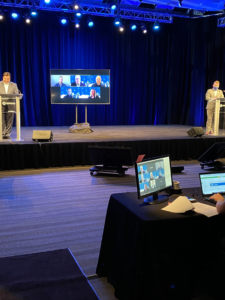 In September, the Metro Denver EDC hosted its annual Site Selection Conference – a series of conversations with national consultants who are hired by America’s Fortune 1000 companies to scout communities on their behalf. Site selectors joined the EDC to tour the Metro Denver region, meet with economic development partners and investor companies, get a broad overview of the business environment and regional assets, and
they offered insights and feedback as to how we, as a community, can best position Metro Denver relative to the needs of prospective companies.
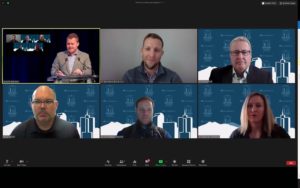 This year’s virtual discussions focused on the pandemic’s impact on economic development, new strategies for recruiting and retaining companies, job creation and our region’s position on expansion and relocation relative to the nation’s top metropolitan areas. One theme consistently rose to the top of our conversations – talent. A focus on people is paramount to helping their clients either choose Colorado – or another state for relocation and expansion. Check out the recap video for 10 key takeaways of the panel.
COMMUNITY CONVERSATIONS ON ISSUES OUR COMMUNITY IS FACING AT THE LEADERSHIP FOUNDATION’S VIRTUAL VOICES
 Our Denver Metro Chamber Leadership Foundation’s Virtual Voices aims to keep alums informed and engaged as our community works through this challenging time. Each virtual meeting brings together leaders on the front lines of impacted industries to share their knowledge, perspectives and leadership lessons. Alumni have convened to talk about mental health, how to talk to their kids about race, creating an inclusive workplace, the power of storytelling and more! Join the upcoming Virtual Voices on Technology Today on Nov. 12.
WELCOMING NEW IMPACT DENVER AND LEADERSHIP DENVER CLASSES
This past September our Denver Metro Chamber Leadership Foundation virtually kicked off the Impact Denver fall 2020 class and Leadership Denver 2021 class. Throughout their program experience leaders will dive deep into issues facing our community, work on group projects, connect with civic leaders and grow their network. We’re excited to see what these leaders will accomplish.
Interested in taking the next step in your leadership journey? Check out the Leadership Foundation’s programs to see which program is right for you.
Applications are open for Access Denver, Colorado’s’ Civic DNA Fellows and Impact Denver spring 2021 class .
CONNECTING BUSINESS AND POLICY AT COLORADO COMPETITIVE COUNCIL’S (C3) BUSINESS BASECAMPS
 This year C3’s Business Basecamp had to adapt due to COVID-19, and it was able to continue forward in a safe, responsible and fun way. Over four basecamps, participants were hosted by Representative Perry Will (R-57) and Representative Julie McCluskie’s (D-61), Representative Mark Baisley (R-39) and Senator Tammy Story’s (D-16), Matt Soper (R-54) and Representative Janice Rich’s (R-55), and Representatives Yadira Caraveo (D-31) and Kyle Mullica’s districts (D-34). They were able to learn about local districts — from local business at the top of Breckenridge Mountain to touring the housing development Sterling Ranch to visiting a working cattle farm and riding RTD’s newly opened N Line.
FOOD AND BEVERAGE COMPANIES WERE ON THE MENU AT DENVER STARTUP WEEK
 Trout Tank CPG Pitch Event highlighted consumer packaged goods (CPG food) and beverage entrepreneurs and businesses in Colorado, giving them opportunities to sharpen their pitching skills, gain exposure, secure funding, and build connections with lenders, investors, decision-makers and key stakeholders within the Colorado business and investing community.
During Denver Startup Week, four companies showed off their innovations in the CPG food and beverage space. Sweet Logic, Patterbar, Green Belly Foods and Mad Lemon competed for a prize pack worth over $3,000 with Sweet Logic taking the final prize.
Applications are currently open for Trout Tank H2O. All businesses with a focus on water, new or old, can participate in order to sharpen pitching skills, gain connections with expert mentors and get awesome exposure opportunities, along with a $5,000 cash prize!
A PEW RESEARCH STUDY REPORTS MORE than half of Americans find the internet to be essential during the COVID-19 outbreak. This finding is not surprising to many people who are reading this magazine; as business leaders and parents who are working and managing learning from home, we know a home internet connection is needed now more than ever. Just pause for a moment and imagine life without internet at home.
While COVID-19 and the related stay-at-home orders put a spotlight on how critical it is to have access to technology and a reliable, high-speed home internet connection, the crisis also exposed even further the cruel irony of the digital divide. Those with home internet connections benefit from all the opportunities of a digital world, but those without fall even further behind.
Some of our most vulnerable populations include low-income and refugee families who suddenly have to adapt to online learning and figuring out how to work from home or search for work virtually for the first time, and seniors who need to stay connected as they isolate away from loved ones can particularly benefit from home connectivity.
How can we come together as civic leaders to address this need to better serve our community? Here are some ways we can work together to ensure greater digital equity and inclusion.
Comprehensive Approach To Digital Inclusion
In order to address the digital divide, we need to think of the issue as more than just a physical home internet connection. There are multiple barriers to connectivity that come into play and make up the reasons why an individual or a family may not have a home internet connection.
Some people lack the digital literacy to understand the benefits a home internet connection can provide. They may not fully realize the equalizing power the internet can provide to them and their family, enabling someone to obtain critical computing skills, search for jobs, access news and health care information and so much more.
Others may only have a smart phone or tablet at home and lack affordable hardware like a laptop or desktop computer. An internet connection is only as good as the device by which it is accessed.
And for others, the price of internet service may be the determining factor. Many people are balancing bills and are unaware of more affordable home internet options.
The good news is that there are numerous broadband companies and various internet offers available to low-income families throughout metro Denver. Comcast, for its part, has offered its Internet Essentials program for nearly a decade. The program is designed to be a wrap-around solution to directly confront every barrier to digital adoption by offering affordable internet at $9.95 per month, subsidized computers and free digital literacy training to eligible low-income families.
If we’re going to build digital equity in Colorado, we must address all three of these barriers and work together to educate our community on the importance of a home connection.
Public-Private Partnerships
As a leader in our community, I know you can appreciate the magnitude of this challenge, and that it’s one requiring all of us to work together to address.
At Comcast we’re constantly evolving our Internet Essentials program to better meet the needs of the community. In March, following the COVID-19 outbreak, we began offering Internet Essentials free for two months for new customers – an offer that will remain available through the end of the year.
We aligned and collaborated with a lot of help from elected officials, school districts and foundations and the nonprofit community to ensure we reached all families and individuals in our community.
We also partnered with nearly a dozen organizations to further cover the cost of home internet connectivity for Internet Essentials-eligible individuals and families who need additional financial assistance through our Internet Essentials Partner Program. The program, which relies on public-private partnerships, enables companies or nonprofits and other organizations to coordinate funding to help connect those who may still be unconnected.
Through creative solutions with local partners, together we’ve connected thousands of people to the power of the internet since March – many for the very first time.
We still have work to do to reach those who remain unconnected; and to ensure they gain the digital skills necessary to learn, work, and access health care and other vital services online.
School districts, foundations and nonprofit organizations cannot take on this massive task their own. And, we as business and community leaders can’t address it on our own. We all have a responsibility to re-imagine how we work together to help raise awareness about the need for connectivity, as well as ensure more people know about what programs and resources are available.
Everyone should have access to the opportunities made possible by having the internet at home. We hope as fellow civic leaders you join us in this work to build digital equity, as when our communities thrive, so do we.
In addition to welcoming Trey Rogers as the chair of the Denver Metro Chamber, its family of organizations – the Colorado Competitive Council, Denver Metro Chamber Leadership Foundation, Denver Metro Small Business Development Center and the Metro Denver Economic Development Corporation – all welcomed new board leadership. They’re part of our collective work to make Colorado a great place to live and do business. Get to know these incoming leaders.
Colorado Competitive Council Chair
Beverly Razon
Senior Vice President of Public Affairs COPIC
 After being engaged with C3 for more than 10 years, “I am excited and humbled at the opportunity to support [C3 Director] Lauren Masias in leading it forward,” Razon said.
And, Razon is ready to get to work: “This unprecedented time presents unprecedented opportunity for C3 to collaborate with, support and represent businesses across the state at the Capitol. This is critical to ensuring Colorado’s policies work to lift up the recovery of our economy in order to keep our citizens working or get them back to work. C3 is well-positioned to represent this statewide voice as we work through thoughtful, balanced policy with our elected leaders on the many issues we know are ahead of us.”
Denver Metro Chamber Leadership Foundation Board Chair
Anthony Graves
Principal, GRAVES CIVIC SOLUTIONS, LLC
 A longtime speaker at the Leadership Foundation’s Leadership Denver program days, Graves has engaged more deeply with the organization as a board member since 2015. A member of Mayor Michael B. Hancock’s cabinet for seven years, Graves recently launched a public affairs and economic development consultancy, and he’s seen an outpouring of support – something that makes doing business in Colorado special: “I love the focus on building long-term, authentic relationships and the personal interest that business leaders take in one another,” Graves said.
But with dual challenges of combatting coronavirus and racial injustice, Graves said the Leadership Foundation, which works to educate and inspire leaders to make a difference in the community, is critical: “This confluence of crises has underscored the importance of developing a pipeline of leaders in our society who can address the intractable challenges of today and prepare for the unknown challenges of tomorrow,” he said.
Denver Metro Small Business Development Center Board Chair
Rob Smith
Executive Director of Rocky Mountain MicroFinance Institute
 Smith returns as Denver Metro SBDC Chair, a role he’s held since 2018: “Ensuring small business has a voice at the table is incredibly important to me.”
“Colorado has a ‘go for it’ spirit,” he said. “If we don’t know how to do it, we figure it out (and we do a really good job at it). There has been a lot of damage done as a result of COVID-19 and the waves of uncertainty and fear it brings, and we’ll see a fundamental re-orientation of our economy as a result. We’re an entrepreneurial state, through and through, and I’m excited to support our path forward through the incredible adaptability and resilience of our small business community.”
Metro Denver Economic Development Corporation Incoming Executive Committee Co-Chair
April Giles
Vice President of Business Development for the Fitzsimons Innovation Community
 Coloradans are up for any challenge, and that’s why Giles loves living and working here: “Time and time again when we call on our community to step up, lead, solve, inspire, mentor – you name it – Coloradans will join in to contribute,” she said.
And, Giles has seen that in action at the Metro Denver EDC. “Issues, such as workforce development, transportation, housing, arts and culture, are at the forefront of their work. Metro Denver EDC intuitively understands that by optimizing complementary economic development ‘systems’ we invest in long-term sustainable results,” she said.
And, she’s proud to serve an industry working on the frontlines to stop the pandemic: “They’ve rolled up their sleeves to serve. Colorado has a number of bioscience companies and hospital systems with high national regards for their work to provide diagnostic tests, leadership on vaccine clinical trials and their daily care of COVID-19 patients.”
Metro Denver Economic Development Corporation Incoming Board of Governors Co-Chair
Paul Washington
Market Director at JLL
 In the year ahead, Washington said he sees a unique opportunity “to brand the Denver region as a thought leader in how it will operate and compete in a post-COVID virtual economy.”
Washington first got to know the Metro Denver EDC as the executive director of Denver’s Office of Economic Development, where he saw how the Metro Denver EDC’s approach – of collaboration and coordination among the companies and municipalities from across the metro area – “distinguishes the Denver region from its competitors.”
And it’s that attitude – “the general culture that people are here to help and that we are in the process of really defining ourselves” – that Washington says makes Colorado a great place to live and work. “This allows for everyone to participate in the legacy of this state,” he said.