SEE HOW OUR MEMBERS HAVE BEEN
virtually connecting and look to see where you can
engage at denverchamber.org/calendar.
NATIONAL EXPERTS OFFER INSIGHTS & ADVICE DURING EDC’S FIRST VIRTUAL SITE SELECTION CONFERENCE
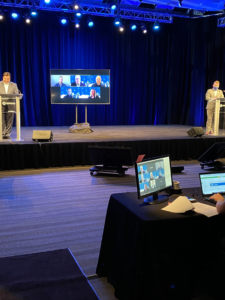 In September, the Metro Denver EDC hosted its annual Site Selection Conference – a series of conversations with national consultants who are hired by America’s Fortune 1000 companies to scout communities on their behalf. Site selectors joined the EDC to tour the Metro Denver region, meet with economic development partners and investor companies, get a broad overview of the business environment and regional assets, and
they offered insights and feedback as to how we, as a community, can best position Metro Denver relative to the needs of prospective companies.
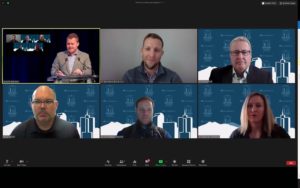 This year’s virtual discussions focused on the pandemic’s impact on economic development, new strategies for recruiting and retaining companies, job creation and our region’s position on expansion and relocation relative to the nation’s top metropolitan areas. One theme consistently rose to the top of our conversations – talent. A focus on people is paramount to helping their clients either choose Colorado – or another state for relocation and expansion. Check out the recap video for 10 key takeaways of the panel.
COMMUNITY CONVERSATIONS ON ISSUES OUR COMMUNITY IS FACING AT THE LEADERSHIP FOUNDATION’S VIRTUAL VOICES
 Our Denver Metro Chamber Leadership Foundation’s Virtual Voices aims to keep alums informed and engaged as our community works through this challenging time. Each virtual meeting brings together leaders on the front lines of impacted industries to share their knowledge, perspectives and leadership lessons. Alumni have convened to talk about mental health, how to talk to their kids about race, creating an inclusive workplace, the power of storytelling and more! Join the upcoming Virtual Voices on Technology Today on Nov. 12.
WELCOMING NEW IMPACT DENVER AND LEADERSHIP DENVER CLASSES
This past September our Denver Metro Chamber Leadership Foundation virtually kicked off the Impact Denver fall 2020 class and Leadership Denver 2021 class. Throughout their program experience leaders will dive deep into issues facing our community, work on group projects, connect with civic leaders and grow their network. We’re excited to see what these leaders will accomplish.
Interested in taking the next step in your leadership journey? Check out the Leadership Foundation’s programs to see which program is right for you.
Applications are open for Access Denver, Colorado’s’ Civic DNA Fellows and Impact Denver spring 2021 class .
CONNECTING BUSINESS AND POLICY AT COLORADO COMPETITIVE COUNCIL’S (C3) BUSINESS BASECAMPS
 This year C3’s Business Basecamp had to adapt due to COVID-19, and it was able to continue forward in a safe, responsible and fun way. Over four basecamps, participants were hosted by Representative Perry Will (R-57) and Representative Julie McCluskie’s (D-61), Representative Mark Baisley (R-39) and Senator Tammy Story’s (D-16), Matt Soper (R-54) and Representative Janice Rich’s (R-55), and Representatives Yadira Caraveo (D-31) and Kyle Mullica’s districts (D-34). They were able to learn about local districts — from local business at the top of Breckenridge Mountain to touring the housing development Sterling Ranch to visiting a working cattle farm and riding RTD’s newly opened N Line.
FOOD AND BEVERAGE COMPANIES WERE ON THE MENU AT DENVER STARTUP WEEK
 Trout Tank CPG Pitch Event highlighted consumer packaged goods (CPG food) and beverage entrepreneurs and businesses in Colorado, giving them opportunities to sharpen their pitching skills, gain exposure, secure funding, and build connections with lenders, investors, decision-makers and key stakeholders within the Colorado business and investing community.
During Denver Startup Week, four companies showed off their innovations in the CPG food and beverage space. Sweet Logic, Patterbar, Green Belly Foods and Mad Lemon competed for a prize pack worth over $3,000 with Sweet Logic taking the final prize.
Applications are currently open for Trout Tank H2O. All businesses with a focus on water, new or old, can participate in order to sharpen pitching skills, gain connections with expert mentors and get awesome exposure opportunities, along with a $5,000 cash prize!
A PEW RESEARCH STUDY REPORTS MORE than half of Americans find the internet to be essential during the COVID-19 outbreak. This finding is not surprising to many people who are reading this magazine; as business leaders and parents who are working and managing learning from home, we know a home internet connection is needed now more than ever. Just pause for a moment and imagine life without internet at home.
While COVID-19 and the related stay-at-home orders put a spotlight on how critical it is to have access to technology and a reliable, high-speed home internet connection, the crisis also exposed even further the cruel irony of the digital divide. Those with home internet connections benefit from all the opportunities of a digital world, but those without fall even further behind.
Some of our most vulnerable populations include low-income and refugee families who suddenly have to adapt to online learning and figuring out how to work from home or search for work virtually for the first time, and seniors who need to stay connected as they isolate away from loved ones can particularly benefit from home connectivity.
How can we come together as civic leaders to address this need to better serve our community? Here are some ways we can work together to ensure greater digital equity and inclusion.
Comprehensive Approach To Digital Inclusion
In order to address the digital divide, we need to think of the issue as more than just a physical home internet connection. There are multiple barriers to connectivity that come into play and make up the reasons why an individual or a family may not have a home internet connection.
Some people lack the digital literacy to understand the benefits a home internet connection can provide. They may not fully realize the equalizing power the internet can provide to them and their family, enabling someone to obtain critical computing skills, search for jobs, access news and health care information and so much more.
Others may only have a smart phone or tablet at home and lack affordable hardware like a laptop or desktop computer. An internet connection is only as good as the device by which it is accessed.
And for others, the price of internet service may be the determining factor. Many people are balancing bills and are unaware of more affordable home internet options.
The good news is that there are numerous broadband companies and various internet offers available to low-income families throughout metro Denver. Comcast, for its part, has offered its Internet Essentials program for nearly a decade. The program is designed to be a wrap-around solution to directly confront every barrier to digital adoption by offering affordable internet at $9.95 per month, subsidized computers and free digital literacy training to eligible low-income families.
If we’re going to build digital equity in Colorado, we must address all three of these barriers and work together to educate our community on the importance of a home connection.
Public-Private Partnerships
As a leader in our community, I know you can appreciate the magnitude of this challenge, and that it’s one requiring all of us to work together to address.
At Comcast we’re constantly evolving our Internet Essentials program to better meet the needs of the community. In March, following the COVID-19 outbreak, we began offering Internet Essentials free for two months for new customers – an offer that will remain available through the end of the year.
We aligned and collaborated with a lot of help from elected officials, school districts and foundations and the nonprofit community to ensure we reached all families and individuals in our community.
We also partnered with nearly a dozen organizations to further cover the cost of home internet connectivity for Internet Essentials-eligible individuals and families who need additional financial assistance through our Internet Essentials Partner Program. The program, which relies on public-private partnerships, enables companies or nonprofits and other organizations to coordinate funding to help connect those who may still be unconnected.
Through creative solutions with local partners, together we’ve connected thousands of people to the power of the internet since March – many for the very first time.
We still have work to do to reach those who remain unconnected; and to ensure they gain the digital skills necessary to learn, work, and access health care and other vital services online.
School districts, foundations and nonprofit organizations cannot take on this massive task their own. And, we as business and community leaders can’t address it on our own. We all have a responsibility to re-imagine how we work together to help raise awareness about the need for connectivity, as well as ensure more people know about what programs and resources are available.
Everyone should have access to the opportunities made possible by having the internet at home. We hope as fellow civic leaders you join us in this work to build digital equity, as when our communities thrive, so do we.
CareerWise Colorado and the Denver Metro Chamber of Commerce are partnering to provide 100 modern youth apprenticeship opportunities with Chamber members in 2020.
“Innovating our talent pipelines is a stated objective in Denver,” said Noel Ginsburg, CareerWise CEO. “Workforce innovation starts with the Chamber. The membership is already leading the way on a number of development and advocacy issues. With this partnership we hope to harness that leadership and supercharge the momentum we’ve been building around youth apprenticeship since we launched three years ago.”
To facilitate the implementation of apprenticeships among member employers, the Chamber has hired Sammy Smith as a dedicated partnership manager. Trained by CareerWise, Smith will be officed at the Chamber and serve as the primary point of contact for members interested in learning more about how to develop talent pipelines for the great jobs they are creating.
“CareerWise is bringing together our companies and our youth to create more pathways to meaningful careers — that’s a win-win,” said Kelly Brough, Denver Metro Chamber of Commerce President and CEO. “We have to make a systemic change in our educational system where we recognize that earning while we are learning is a powerful way to meet our future workforce needs. We are proud to partner with CareerWise to create more apprenticeship opportunities and great careers for Coloradans.”
CareerWise apprentices are onsite with more than 100 companies in modern job functions such as financial services, business operations and IT. Apprenticeship is a work-based learning model that is prepares workers to step into full-time roles by having them perform meaningful, productive work and completing related classroom instruction.
“Apprenticeship is more than an internship—it’s not learning through exposure to work, it’s learning through work. And because of that, there is real value in creating these positions for employers,” Ginsburg said. “It’s not philanthropy; it’s smart business.”
Are you a business interested in an apprenticeship opportunity? Contact Sammy Smith at sammy.smith@denverchamber.org or 303-620-8050.
Education Bills: Getting Students through School with Credits and Real-World Work Experience
This week the Chamber supported three education bills that will provide additional opportunities for educational attainment for our students. Education is among our pillars to build a strong economy – talent is the most valuable asset for employers and is what attracts great employers to our region.
Senate Bill 216 is a pilot program that will allow participating schools to create innovative learning plans for their students. These plans could include opportunities to participate in apprenticeships with local businesses, competency-based learning projects and capstone projects, among others. The “seat-time” requirement in today’s school funding laws is frequently cited as a barrier for some schools to participate in such programs, and this bill hopes to address that and, subsequently, increase participation.
Senate Bill 176 modernizes current concurrent enrollment opportunities and requires that they lead to guaranteed transferable credit across all Colorado institutions. Students need to know that the concurrent courses they take in high school will be accepted for credit when they move on to college. By 2020, 74 percent of jobs will require some type of education beyond high school. Colorado’s existing labor force has a credential attainment rate of only 57 percent beyond high school, and only 43 percent of Colorado's ninth graders are attempting to obtain a college degree. We must get every child to and through some level of post-secondary education to maintain Colorado’s competitive advantage.
The Chamber also supported House Bill 1252, which allows students and members of the current workforce to receive postsecondary credit for demonstrating competencies gained through work-related experience, work-based learning and apprenticeships. A statewide plan will be implemented to accomplish this to ensure that these opportunities are captured across Colorado. This legislation is modeled after a 2017 college credit program for members of the military, which passed unanimously and established a framework for prior learning while in service to count for postsecondary credit.
Oil and Gas Bill Heads to the Governor’s Office for Signature
Senate Bill 181, the comprehensive oil and natural gas legislation that has flown through the legislature, now heads to the governor’s office for signature after the Senate accepted the amendments added in the House. While the Chamber and the industry are still in opposition to the bill, credit should be given to legislative leaders who opened up to conversations with industry experts and accepted a few critical amendments that provide a level of certainty to oil and gas developers. Amendments include ensuring that fines, fees, setback distances and other regulations are reasonable, a request our president and CEO, Kelly Brough, included in her testimony last week. Amendments also removed the authority of the Colorado Oil and Gas Conservation Commission’s (COGCC) director to refuse issuing a permit and to make the COGCC a professional commission rather than the volunteer commission it is now. State officials have also committed to working with the industry during the regulatory rulemaking that will follow the bill.
Follow the Session
As always, Chamber staff will continue working on your behalf, analyzing and weighing in on legislation that can impact your business. We list all our bill positions online. Stay in touch with us by checking our website and sharing with us your concerns as the session progresses.
A smart, healthy workforce is the (not so secret) secret to our success. It’s critical that we grow that talent base with Colorado’s youth to continue that success, because in just a little over a year our economy will demand the most-educated workforce in the country, with 74 percent of jobs requiring some postsecondary education.
There’s a lot that goes into building a strong economy and putting Coloradans to work in great careers, and this week, we want to focus on the Chamber affiliate that enhances that work by focusing on youth: the Denver Opportunity Youth Initiative.
This initiative of the Chamber works with nearly 150 businesses and 24 community partners to reengage youth aged 16 to 24 who have become disconnected from school and work. The initiative brings together the right organizations to help youth:
So, who are opportunity youth? When we launched the effort back in 2014, there were more than 10,000 youth in Denver alone. Today, there are about 8,800 and the initiative just released a report offering a better picture of who these youth are:
What we have found – with a little support, some connections and encouragement, our kids are thriving and finding their way into great jobs and careers. We need businesses like yours to lend your support. Join us!
Kelly Brough is the president and CEO of the Denver Metro Chamber.
By Joe Garcia and Phil Kalin
The lines between the classroom and the workplace are blurring. And rightly so, considering that 85 percent of jobs that will exist in 2030 haven’t been invented yet. With that level of breakneck change and the stunning reality that 74 percent of Colorado’s jobs will require a post-secondary credential in just two years, now is the time to work together to protect our future economic success.
We know with numbers like these it is no longer just a school’s job to educate, nor is it just a business owner’s job to train an employee. While the jobs of tomorrow may not be clear, what is clear are the kinds of skills our workforce will need to be successful – critical thinking, adaptability and working collaboratively – coupled with the ability to take on new hard skills to pivot to those careers when the time comes.
Last week we discussed what that education of our workforce will look like with business and community leaders at the Denver Metro Chamber of Commerce’s State of the City. Our message was clear: Business and education leaders must partner and collaborate closely, because what we’ve already seen come out of these partnerships is increased opportunity for all.
Pinnacol Assurance has taken on more than 30 apprentices through a partnership with CareerWise Colorado – more than any other employer in the state that is working with this modern approach to traditional apprenticeship learning. Those apprentices work in a variety of roles, from marketing to accounting. The students earn while they learn, balancing time between the workplace and classroom, receiving up to 40 hours debt-free college credit and making up to $15 per hour. One year into this three-year program, Pinnacol is already seeing strong ROI, and also understands that long-term this investment helps fuel a pipeline of workers ready for the job who understand the culture of the organization.
Schools that partner with businesses have recognized the important shift in how we learn and work. It’s making educators more nimble and it’s equipping students to likewise be nimble, curious life-long learners – the kind of skills critical to future success. For decades, community colleges and universities have partnered with the private sector, and those partnerships are becoming increasingly important today.
For example, a recent partnership between Arapahoe Community College and Centura Health has led to the creation of a paid, six-month apprenticeship for a dozen medical assistant students. The program’s on-site and hands-on laboratory components, facilitated by Centura supervisors, will give these students a competitive advantage prior to taking their national certification exam and a direct path to becoming full-time employees with the hospital.
Only 18 of every 100 Colorado students will graduate from high school, complete their degree or certificate and immediately start a job, according to the Colorado Talent Pipeline Report. What happens to the others? We must recognize this important population and the hard work ahead to improve outcomes for their success in education, our workforce and their quality of life.
Meanwhile, we know many jobs are going unfilled. And with an all-time low unemployment rate, it’s all hands on deck to ensure Coloradans have access to education and relevant training opportunities to thrive in our growing economy.
Whether through a commitment like an apprenticeship program or other opportunities such as job shadowing, office tours and internships, we urge more businesses and educators to partner. We are stronger together, and we’ll build a stronger Colorado when we work together.
Joe Garcia is the President of the Colorado Community College System (CCCS), providing leadership, advocacy and support to the state’s largest system of higher education, which serves 137,000 students annually at 13 colleges and 40 locations across Colorado. Prior to his role at CCCS, Garcia served as president of the Western Interstate Commission for Higher Education, and from 2011 to 2016 was lieutenant governor of Colorado and executive director of the Colorado Department of Higher Education.
Phil Kalin is the president and CEO of Pinnacol Assurance, Colorado’s leading workers’ compensation insurer. Kalin is a national expert on topics related to health care, insurance, data analytics, technology innovation, cost improvement and risk mitigation.
The Denver metro area has a vibrant health care economy – employment has increased in this sector every year since 2004, adding over 88,420 workers. But, there are still thousands of positions in the health care industry that need to be filled.
While many educators and parents worried about the summer melt, the Denver Opportunity Youth Initiative (DOYI) was igniting new interest in the industry among students.
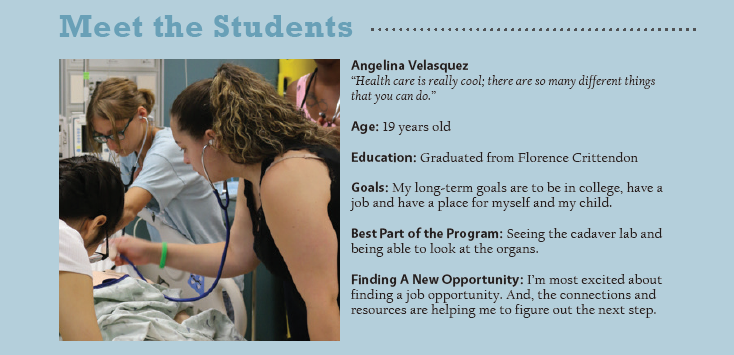
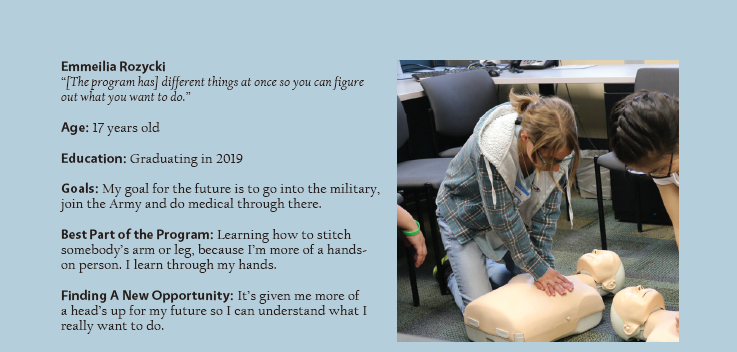
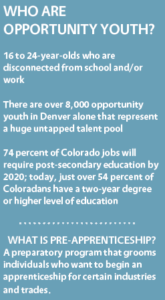 The Chamber affiliate, in partnership with the Greater Metro Denver Health Care Partnership, Adams County Workforce Center, Denver Workforce Services, Arapahoe Douglas Workforce Center and the Central Colorado Area Health Education Center (AHEC) provided a unique health care learning opportunity for opportunity youth, a Health Care Pre-Apprenticeship Pilot.
“We recognize that we can only accomplish large and lasting social change if we all come together,” said Jenny Smith, talent pipeline liaison for DOYI. “The Health Care Pre-Apprenticeship program brings together community-based organizations, employers and local workforce centers to accomplish a common goal of creating a training on-ramp for young adults into health care careers.”
Meeting over three weeks, youth who ranged in age from 16 to 24 explored different careers in health care, met industry professionals, participated in hands-on activities and received entry-level certifications – preparing them for the next step in a career in health care. This is the first industry they’ve focused on, with plans to move into other in-demand spaces, such as IT.
“During the program we went over soft-skill training, but the main focus was hands-on activities,” said Mitch Fittro, education and workforce manager for Central Colorado AHEC, noting the youth saw all aspects of the health care industry, touring a cadaver lab, animal research facilities and Colvaria Hospitality, while receiving first aid training and a basic lifesaving certification. “They really get to feel a part of the health care community.”
Why health care? Every year there are 4,500 different positions that go unfulfilled in the health care industry. And, not every position requires a college degree.
“Opportunity youth represent an untapped talent pool that are resilient, have often been the care-taker for one of their family members and have the grit and perseverance needed to be successful in these jobs, which is just what employers are looking for,” Smith said.
Erin Lawless, director of human resources for Colavria Hospitality, a management and consulting firm for nursing home facilities, said opportunities like the pre-apprenticeship program are a great way to engage people who are ready to learn.
“This generation of students really want to make a difference, and health care is an excellent opportunity to make a difference,” she said.
Students were able to learn about the health care industry and all of the opportunities available to them to jump start their career, and employers were able to “widen our scope of who we appeal to from a job candidate perspective,” Lawless said.
And, a spark was ignited. Students could see where their careers could go and received the tools necessary to do so.
“You can see the light bulb go on,” Fittro said. “[The students] realize what they want to do and are determined to find the steps to get themselves to that point as well.”
Creating partnerships and programs like these allow for an industry to come together to address their workforce needs, Smith said, and it allows our community to “build the smart, skilled workforce we need for our future … it enables us to move families out of poverty, fill in-demand jobs and keep Colorado’s economy strong.”
Are you a business that would like to be involved with upcoming pre-apprenticeship programs? Contact jenny.smith@denverchamber.org for more information.
Laura James is the senior marketing specialist for the Denver Metro Chamber.