There’s plenty of positive economic momentum for the metro Denver region, economist Patty Silverstein told more than 300 business leaders at State of Small Business this morning.
On track to add more than 40,000 new jobs to the area, a low unemployment rate, a diverse economy and nearly 1 million positions filled by sole proprietors are among some of the keys indicators of that success, she said.
In fact, Colorado ranks fourth for concentration of sole proprietors: “Needless to say that is a huge force in Colorado,” said Silverstein, president and chief economist of Development Research Partners.
The event was hosted by the Denver Metro Chamber of Commerce and the Denver Metro Small Business Development Center in partnership with the Daniels Fund Ethics Initiative at the University of Colorado Denver Business School.
With growth comes challenges, Silverstein said, noting the cost of housing, the challenge of finding workers in a competitive economy and broader forces, like tariffs and a growing national debt.
Locally, she noted that wages are rising and home prices are moderating. Another force creating change? Technology. And, Silverstein said that was no surprise given that the metro area ranks eighth for employment concentration of IT-software industry workers.
“Technology is changing the way we work, the way we live,” Silverstein said. “A lot of that technology is happening here in Colorado.”
AI, Automation Present Challenges, Opportunities for Small Businesses
That speed of change that technology brings can often create fear – particularly about questions of whether jobs will go away, said Chamber President and CEO Kelly Brough. But, she pointed out that even as technology removes some tasks, or even some jobs, World Economic Forum estimates that 133 million new roles may emerge globally by 2022 – and that’s nearly double the jobs that could be eliminated by technologies like automation.
Three small business leaders shared how they are making use of these technologies and helping other businesses take advantage of them.
“If we can get one or two tasks off their plate that’s going to free them up ... we see that as the first phase in this movement,” said Frank Trevino, who leads artificial intelligence and digital transformation strategy and engagement for Tinman Kinetics.
At Tinman, they work with small businesses to take advantage of technology that can help them get better data and connect more with their customers, but he cautions against “shiny object syndrome,” using technology for technology’s sake.
While the use of more technology in business can lead to several “micro-disruptions,” once a team is using more automation it makes their work – and their focus on strategic initiatives in your business – that much more critical said Bill Sinclair, chief technology officer and interim president and CEO of SALT.
That “tribal knowledge,” must be archived: “We have to make sure they’re capturing that knowledge, otherwise it could cause massive disruption to our business,” he said.
While Mark Spiecker is pioneering one of the first pharmacies in the country that will fill and compound prescription drugs only with robotics, how he approaches his business – from finding partners to train and build the workforce he needs to focusing on relationships to build his business – won’t change.
“It’s really those ethics of how we operate and how we do business that’s critical to our future success,” said Spiecker, president of STAQ Pharma.
Greg Anton Named 2018 Bill Daniels Ethical Leader of the Year
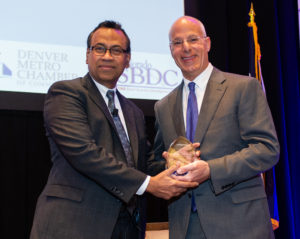
For the fourth year, the Daniels Fund Ethics Initiative at the University of Colorado Denver Business School, in partnership with the Chamber and the Denver Metro SBDC, awarded the Bill Daniels Ethical Leader of the Year. Greg Anton, chairman and CEO of ACM, was recognized as this year’s honoree.
The award is named in honor of Daniels, the cable television pioneer, and the ethical principles he stood for: integrity, trust, accountability, fairness, respect, transparency, viability and rule of law.
“Greg and his business partners embody these values right from the top,” said University of Colorado Denver Business School Dean Rohan Christie-David.
Anton said he was humbled by the recognition
“Trust, ethics, and integrity are core values for me personally and professionally,” Anton told the University of Colorado Denver School of Business. “Ethical business practices are the foundation of a strong and sustainable community.”
Learn more about Anton:
Sara Crocker is the communications manager for the Denver Metro Chamber.
As a small business, you probably don’t think automation or artificial intelligence will have an impact on your business. But take it from three small business leaders who work in the tech space – it will, and now is the time to learn how you can get ready (and make the most of tools already available).
Take administrative tasks off your to-dos. Would you rather work on day-to-day items or your business’s goals and strategy? The reality is that the average entrepreneur spends 68.1 percent of their time on the day-to-day and 31.9 percent working on goals and strategy, according to a survey from The Alternative Board. That’s why at SALT, Bill Sinclair’s team uses tools like Clara Labs to automate appointment bookings and Lattice to add customer feedback to the staff’s performance reviews.
Create a culture that’s quick to adopt, quick to adapt – but stay true to your goals. There can be so many tech options out there, that it can be easy to get distracted “shiny object syndrome,” says Tinman Kinetics’ Frank Trevino. He should know – his company was born out of the IBM Watson AI XPRIZE, and they work to empower small and mid-sized businesses with software they need to work smarter. But, he cautions that technology can’t substitute for focusing on your people and your process.
Don’t forget the foundation of your business. That means not forgetting the human element, no matter what you automate in your business. Mark Spiecker is building a pharmacy where prescriptions will be filled by robots. While that will make STAQ Pharma different from pharmacies across the country, he says that the relationships that make his business run are still key.
Want to hear more? Join us at State of Small Business on Wednesday, Nov. 7.
Sara Crocker is the communications manager for the Denver Metro Chamber.
When it comes to spreading the word about what you do, a tradeshow or conference can be a way to get in front of a target audience. That’s why twice a year the Denver Metro Chamber of Commerce hosts Net90 MarketPlace, where more than 300 members and 30 exhibitors come together to showcase their products and services.
Before you buy your booth, heed these tips:
Get Creative. You know the phrase, “you eat with your eyes first”? The same goes for exhibitor booths. Attendees will be much more likely to visit a booth that’s more visually appealing than just a table covered in pieces of paper.
Promotional items go a long way. Handing out a little swag is a great way to attract attention, especially if it’s something people will use regularly. Think flash drives or sunglasses, not stress balls and lanyards. Make sure you have the chance to talk with each attendee or even snag a business card before they run off with your goodies.
Use social media. Even though you’ll be visiting with attendees in person, it doesn’t hurt to let everyone know what they’re missing if they’re not there. Also, if you have your own Wi-Fi hot spot, bring it with you. You never know what the Internet connection will be like at the venue, and you don’t want that to get in the way of live streaming your activity to your fans and followers.
Don’t hide behind your booth the whole time. Bring a couple staff members with you to the event and have one or two people stationed at the booth while someone else goes out and works the crowd. This is a great way to bring guests back to your booth for more information and even check out some of the other booths for future ideas.
Arrive early. This might seem like a given, but allow yourself plenty of time to set up. If something goes wrong or you forget something, you don’t want to be making last-minute changes while attendees are arriving. If possible, set-up earlier in the day and then come back before the event starts.
Looking to try exhibiting as part of your marketing plan or simply want to check out member's booths? Join the Chamber’s Net90 MarketPlace on Oct. 16.
Kathryn Goggin was a former events specialist with the Denver Metro Chamber .
When you think of your target audience for your business, does the Hispanic population play a role? If it doesn’t, you’re missing a big – and growing – opportunity, business and sales leaders say.
Consider the numbers: In the last year, 51 percent of the U.S.’s 2.2 million-person population growth was among Hispanics. Here in Denver, the Hispanic population is expected to grow nearly 10 percent over the next five years. And their purchasing power here is anticipated to grow to almost $30 billion by 2024, up from nearly $16 billion in 2014.
“This is a market that should definitely be considered in your marketing strategy,” Abel Corral, a local sales manager for Telemundo Denver, told Gold-level Denver Metro Chamber members at a recent Gold Program.
Telemundo Denver President and General Manager Andres Chaparro agreed.
“When more than 21 percent of the total population in Colorado, more than 32 percent in Denver County and at least 66 percent of students in Denver Public Schools are Hispanics, those figures should spark the interest of any company or organization to learn about our Hispanic community,” he said. “They have an annual buying power and consumer spending of at least $16 billion, and I ask everyone, are you getting your fair share?”
So, you’re ready to start segmenting your marketing audiences – but do you know where to start? Business and marketing experts offered their tips, based on their own experiences marketing to a Hispanic audience.
Do your homework
No matter the audience demographic, you need to “dig a little bit deeper … think about who you’re trying to target,” Laura Sonderup, managing director of Heinrich Hispanidad a multicultural communications firm that is a division of marketing agency Heinrich.
That also means deciding on what your measures of success are – which may help you further segment that audience and find the right places to spend your ad budget – and your time building relationships.
Meet people where they are
Strong relations build life-long customers and referrals.
“Go to the people … they want to connect to you,” advises Sawaya Law Firm Managing Senior Partner Michael Sawaya.
When the Denver Broncos focused on growing their Hispanic audience – their “fanaticos” – they began hosting more events at the stadium, and they went to neighborhoods where their fanaticos live, serving carne asada and introducing fans to Myles the mascot and Broncos cheerleaders.
“It’s about being authentic,” said Ted Santiago, the Broncos’ director of marketing.
They’ve grown those events by 50 to 60 percent, says Fan Development Manager Marisol Villagomez.
“We knew that we had to put in the time to develop trust,” she said.
Create loyalty – in good times and bad
For the Broncos, that means even during a losing season that people still feel connected to the team.
“We want our fans to feel a part of our success,” Santiago said. “When we lose, we want them to be mad; we want them to feel that pain … we want them to feel this is going to get better and I’m a part of this through good and bad.”
Language matters
Experts agreed that while younger generations of Hispanics speak more English and consumer more English-language media, but Telemundo National Sales Manager Drew Wilson emphasized that Spanish is a language of comfort for native speakers.
“More important,” he added, “it’s the language we make decisions in.”
Villagomez agreed: “I work in English; I think and I feel in Spanish.”
And, it means better conversation: Spanish-language ads were four times more effective in driving sales than their English-language counterparts.
So, while adding “se habla Español” to your business card is a good start at building trust and differentiating yourself from your competitors, Corral said, “imagine what the next level is.”
A note on our usage of the term Hispanic: Our panelists noted that there is a debate on whether Hispanic, Latino or Chicano best identifies this audience. We use the term Hispanic to mirror the usage from the data shared during this program.
Sara Crocker is the communications manager for the Denver Metro Chamber of Commerce.
Congratulations! You've launched your business, hired the right people and operations are humming along smoothly. But before you get too comfortable with success, realize it won’t be too long before you need to gear up for the next step of you company: Growth.
In order to effectively compete in the market, leaders must celebrate successes but also keep an eye on progress. To achieve this, they need to create an organizational culture that encourages and supports continuous growth on the corporate, cultural and individual level.
Here are three things leaders can do to construct a corporate environment built for advancement.
Appoint informal leaders. As you communicate your vision, mission and strategy, you’ll want the rest of the company to be on board, too. Just because employees submit to directives, doesn’t mean they embrace it. For successful implementation and companywide buy-in, you’ll need to appoint informal leaders throughout your company.
These informal leaders can translate initiatives in a way that’s relevant to the rest of the staff and serve as crucial sounding boards for your ideas. Their on-the-ground perspective can provide key insights that may not have jumped out at first blush, and their keen eye may help refine and finalize your corporate strategy and communication plan.
Let people own their work. On top of informal leaders, you’ll also need formally appointed people who will be in charge of these new projects and processes. By sharing responsibility, people can infuse their own unique ideas and creativity, take ownership of their work and see how their efforts contribute to the overarching vision.
For this to be successful, make sure each project has an appointed leader, with clearly defined roles and tasks. Each team member should know what they’re responsible for and how metrics for success will be measured. They should also know how their work furthers the company vision, and, perhaps most importantly, see how these new responsibilities directly help them achieve their personal career goals.
Establish effective processes. Just like with individual growth, it’s crucial to document corporate transformation with clearly defined goals and metrics for success. This may come as a surprise, but documentation doesn’t need to be a complex process. For example, our Comcast Business Cloud Solutions allow businesses to collaborate through a wide variety of powerful software tools, such as a file sharing and web conferencing. Regularly updated spreadsheets can also suffice. The goal is to ensure every task and expenditure of energy and time helps achieve the company vision.
Documents can also be supported by checklists that ask simple but key questions like, “Have we met as a group? Are we regularly brainstorming? When’s the last time we checked our work?” By creating a checklist, managers are anticipating unforeseen changes, keeping track with simple project management tools and providing documentation for overcoming future obstacles and challenges.
Our Comcast Business customers in Colorado know change is an inevitable part of growth, but building an environment fit for continuous change doesn’t have to be complicated. By appointing informal leaders as sounding boards, letting staff take ownership of their work and establishing effective processes, change can be a positive and predictable part of your company culture.
Stay in the know with more resources from Comcast Business.
Shawn Adamson is the vice president of Comcast Business for the Mountain West Region
Step One - Be Memorable
Your blog name is important – it’s how people find you. This is how search engines direct people to you. Be sure to put some serious thought into it your blog name.
A very few years ago, few people had ever heard of a “blog.” But as technology grew, we all wanted more. It started with businesses. They designed blogs that introduced their company to the world. They added questions that most people called about. You can do the same – find out what you customers are asking and tailor your blog to it.
Step Two - Content is King!
Always give your reader a reason to come back to your blog. Encourage them to share your blog. Be sure to keep in mind your customers are a diverse group of people. Where some like to read, other skip the reading and go straight to videos and apps. Use a variety of content for your blog. If possible, change your site up at least twice every month. And, don’t forget to change photos.
Step Three – Your Blog is a Marketing Tool
Market from your blog! It is marketing gold. This is where folks can get answers to their questions. They can talk to people who have used your project. This is like having a salesman in someone's dining room.
Ask questions. Ask your customers if they were treated well. Did the product perform for them? Your blog is a great way to get to know your customers and start that conversation to learn from them.
Step Four – Find Partnerships
Network! Speak to the people who are connected in your industry. They do not have to be your competitor. For example, maybe your company does house repairs. You are probably asked from time to time if you know a good painter, plumber or electrician. By posting a link on your site for them, and them putting a spot on their site for you, you are networking – and building those partnerships that showcase both of your expertise.
Step Five – Take Care of Your Blog
Make it someone’s job in your office to monitor the blog – customer questions should be addressed in a timely matter. And, learn how to optimize your blog through Google and other search engines. Use SEO (search engine optimization) and keywords to help your customers find what they are looking for. Keywords help your blog get you to the top of a search. But, be cautious in the number of keywords you use – overuse of keywords can end up diluting the search of your blog rather than strengthening it.
Be smart, have a blog and use it to showcase your expertise. You’ll be glad you did.
Ashley Lipman content marketing specialist.
Every day, more than 1 million people become victims of cybercrime. Here are three quick and easy tips to protect yourself and your company.
This was originally posted by Chamber member CCIG. Click here to view the post.