The agriculture industry may be the last great digital frontier.
It is the least digitized industry in the U.S. at a time when even the metrics for measuring tech adoption will be out of date the next day, according to a McKinsey Global Institute report. But, on the other side of the coin, those working to integrate tech into ag – with the goal of increasing efficiencies and profit margins – stand to make hay.
Agriculture is one of Colorado's oldest industries and today creates $41 billion in annual economic impact. The values embedded in that heritage still permeate how many here learn to do business. Meet a startup, a major miller and a university who are leading
the tech charge to build a better ag system while keeping that Colorado spirit of doing business:
GeoVisual Analytics: “Let’s give you a tool to be as good as your grandfather.”
 Charles McGregor’s background is in intellectual property, not farming. As business unit manager for Boulder-based GeoVisual Analytics, he’s had a crash course in fresh produce – how it grows, what types of fungus can affect it and how he can help farmers plan better to improve their harvests and avoid food waste.
“We want (farmers) to have transparency in the operations so they can have a better tool to make decisions,” he said. “We don’t tell farmers how to farm; we just give them more information and better tools to do the things they do better than anybody else.”
By using imagery collected through planes, drones and mobile phones, they can help farmers count their crops, get a full picture
of how close they are to harvest and what that harvest will yield. With the help of NASA-backed image analysis and artificial intelligence, farmers can build better crop forecasts. That also means they won’t have to overplant – McGregor says farmers often overplant fields by 30 percent.
It matters, he said, because “we have to get healthy food on people’s tables cost effectively.”
Getting into the California-based THRIVE AgTech accelerator and building industry partnerships gave them the “field cred” they needed among potential customers, and they solidify that cred by adding value quickly, McGregor said, particularly as many farmers retire and a new generation joins the field.
GeoVisual Analytics chose to do business in Colorado because “people genuinely want to work together,” McGregor said.
The tech opportunities in ag are practically endless, McGregor said – cautioning that it can be a problem: “Startups don’t die because of lack of opportunity; they drown in a sea of opportunity.”
That means testing and working closely with farmers is critical, said President and CEO Jeffrey Orrey: “Because there’s historically been so little technology in ag, that iterative process has been so critical.”
Ardent Mills: “You can change outcomes by working together.”
 With an innovation center that opened last year that includes a high-precision lab, a bakery to test grains and a research and development facility, Ardent Mills is committed to being on the leading edge. They upped the ante in March by announcing The Annex by Ardent Mills – a new specialty space where they are exploring what’s next in grains, particularly gluten free and ancient and heirloom varieties.
“We’re a very big flour company but we want to be able to think small,” said Shrene White, the general manager of The Annex by Ardent Mills.
Being headquartered in Denver is important to this kind of innovation because of that agricultural history and the state’s love of gastronomy.
“It’s very much a foodie area,” Kent Juliot said of the state. As VP of research, quality and technical services – tasked with leading the development of new grain products – “we consider it a great advantage having our innovation center here.”
That foodie focus also allowed them to provide a “farm to fork” view of their business, from visiting a grower, to milling the grain, to testing it at the innovation center, to seeing those products used in a restaurant.
It also means they can forge strong relationships with growers, innovative universities like Colorado State – who workedwith them to develop a white whole-wheat variety called Snowmass – and with those who will eventually cook and bake with their products.
The Annex provides that opportunity to “cultivate new ideas, to build relationships,” White said.
And, those relationships with more than 1,000 farmers are critical as Ardent Mills helps them introduce new crops into their rotation and support sustainability practices, such as reducing water use and greenhouse gases.
“Really, it’s just helping them understand the tools that are out there,” White said.
Because of that trust, they can be a conduit to helping their farmers try new tech, said Ardent Mills COO Bill Stoufer: “We can put in technology on our end and when we sit down with the growers, they want to know.”
Colorado State University: “The interaction and collaboration built inside the building will be what makes this space important.”
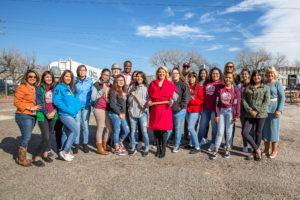 Colorado State University has broken ground on what will be a three-building campus at the National Western Center that will foster new ideas and research to feed and water a growing world.
There will be 9 billion people in the world by 2050, said Amy Parsons, executive vice chancellor of the CSU System, and the food system in its current form cannot sustain that growth.
“Innovation is key to solving these immense issues, and collaboration has to be a large part of finding the answers,” Parsons said. “CSU has a long history of incubating new technologies, collaborating across industries and with other institutions, and providing the research to move concepts forward.”
CSU is one of five partners, which also include the City and County of Denver, the National Western Stock Show, the Denver Museum of Nature & Science and History Colorado, leading the redevelopment of the National Western Center.
The goal is for the renewed center to be a global destination for agricultural heritage and innovation. In addition to continuing to be home to the National Western Stock Show, the center will include three CSU buildings that focus on what’s next for the West, with a water resources center in partnership with Denver Water; a center that explores food systems and provides classroom and lab space as well as agribusiness incubation; and a facility for equine-sports medicine, equine-assisted therapies and education.
The build-out timeline for the National Western Center hasn’t been finalized, but there are estimates of a five-to-10-year build schedule for the CSU buildings.
Because of that timeline, CSU is working to build its presence in the community now in the Globeville, Elyria and Swansea neighborhoods. That means bringing in experiences that will be part of the future campus, from equine-assisted therapy and an annual health clinic for pets and their owners to providing free soil health kits and creating interactive science experiences at Bruce Randolph School.
With this campus, there will be space where people can share ideas and collaborate. That is critical to moving ideas forward and not isolating them in a research facility, Parsons said: “We cannot solve the problems we face without fresh approaches, and diverse minds.”
Sara Crocker is the communications manager for the Denver Metro Chamber
This was originally published in the Chamber's magazine, Business Altitude. Click here to see the entire issue.
The Denver Metro Chamber of Commerce’s Business Awards celebrate organizations from across the region who are leading in their field and making an impact in the community – writing our next chapter as a great community to live and do business.
Meet the 2018 Large Nonprofit Organization of the Year finalists: Denver Urban Scholars, Emily Griffith Foundation and STRIVE Preparatory Schools. The winner will be announced live on April 27.
Denver Urban Scholars Driven by Deep Connections
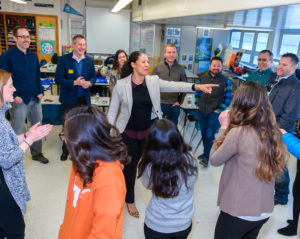 For the past 20 years, Denver Urban Scholars has been partnering with high poverty, high performing schools to unlock the potential of students facing added challenges by creating individual pathways to career and college.
Denver Urban Scholars was founded by the family of now President and CEO Patrick Byrne in 1995. “We’re working to improve the lives of Coloradans,” Byrne said.
Serving over 500 youth – from middle school through post-secondary – their student graduation rate is 94 percent, compared to Denver’s 67 percent rate overall.
“Last school year, 95 percent of our students moved on to the next grade level on time, 94 percent of students graduated,” Denver Urban Scholars Chief Operating Officer Susan Duncombe said. “And 88 percent of students went on to post-secondary.”
The deep relationships that are developed through mentoring is one nod to their success. With about 100 mentors a year, these relationships often last up to 10 years and verge on becoming a part of the family. Relationships matter to Denver Urban Scholars. Their mission to build trust and accountability with a personalized program, experienced staff and deeply committed volunteers.
Working across all sectors and partnering with schools and community organizations, they have built an intervention model that meets youth where they are.
“I am really excited about the future of Denver Urban Scholars,” Byrne said. “I think it is so important that within Denver, we're working with the nonprofit sector, with the corporate sector, public sector, together in partnership to create change in people's lives.”
With a bright future ahead, Denver Urban Scholars’ vision is to continue to increase graduation rates, while also bringing communities together.
Emily Griffith Foundation Keeps Students Debt-Free
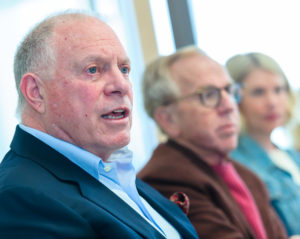 “Emily Griffith was a woman who couldn’t vote for president but could change education forever.”
Her vision was one of education for all who want to learn, said Alby Segall, president of the Emily Griffith Foundation. Just as important is getting that education with no debt.
Emily Griffith Technical College (EGTC) was founded on three principals: open admission for all, changing curriculum based on workforce needs and to be 100 percent debt-free for all students. The Emily Griffith Foundation was founded in 1991 to provide scholarships, capital improvements, classroom equipment and new programs seed money, for what has become one of the most successful technical colleges.
Through partnerships with individuals, foundations, corporations and government organizations, the Foundation can provide scholarship opportunities for students who are in most need of extra support. EGTC’s programs are focused on keeping tuition rates as affordable as possible while insuring instruction, classroom equipment and student supports remain exceptional.
In addition, the Foundation’s 360 Degree Fund, students may receive up to $500 for immediate assistance with crises that interfere with their schooling. They may apply for 360 Degree funds three times in a year before receiving financial counseling.
Emily Griffith Foundation has a wide net of community partners who provide funds to the foundation. They work closely to get a pulse on the workforce needs and work together on how to help fill gaps with specialized training. The workforce pipeline is beneficial to the students, the school, the companies and the overall economic health in the metro Denver region.
“We train our students to meet the needs of the new economy,” Segall said. “We are really a model for the workforce education for the future.”
STRIVE Preparatory Schools Grows Access to Education for All
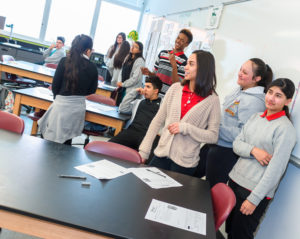 “Education is for improving the lives of others and for leaving your community and world better than you found it,” reads one quote by Marian Wright Edelman on the wall of STRIVE Preparatory Schools’ RISE Campus.
STRIVE Preparatory Schools (STRIVE Prep) is a Denver-based free, open enrollment, public charter school. Founded in 2006 under the belief that students from all backgrounds deserve a quality college preparatory education regardless of race, economic circumstance or previous academic achievement, STRIVE Prep has now grown to 11 schools and serves 3,700 students.
“Education is the most powerful way to change communities,” Founder and CEO Chris Gibbons said.
School locations were based on getting quality schools into under-served neighborhoods, allowing kids down the street or around the block to have a place to go.
Historically, one of 10 students graduate from college in the neighborhoods that STRIVE Prep serves – which is a community of 91 percent free and reduced lunch and 97 percent of color. Today, 94 percent of graduates have been accepted to a four-year college – many of whom are first-generation college students.
Gibbons belief was one that all students, no matter the challenge, could and should receive a good education. “We're always seeking to build an empowering, joyful school community that also has really high expectations for our students,” Gibbons said.
When you walk into a STRIVE Prep school, you can feel that the environment is centered around inclusivity and the students. The energy trickles down to the staff and the families.
Knowledge, skills and mindsets to get to and through college to career. “Think, know, do and go” is one of many motto’s around STRIVE Prep, encouraging success for all.
Maggie McEntee is the digital communications and brand manager for the Denver Metro Chamber.