 Laura Giocomo Rizzo, current vice president of communications and marketing for the Denver Metro Chamber of Commerce, has been named senior vice president of external affairs for the organization. The SVP of external affairs represents a combination of two previous leadership roles at the Chamber – VP of government affairs and VP of communications and marketing. Accordingly, in her new role Rizzo will oversee marketing, communications, government and public affairs and events for the Chamber. She assumes the role June 3.
“Laura is a proven leader at the Chamber, having played a key role in transforming our marketing and communications efforts here. Her deep understanding of public policy, paired with her strategic communications expertise will serve our members and team well, and we’re eager for her to apply her leadership to our government affairs team,” said Kelly Brough, president and CEO of the Chamber.
Rizzo has led marketing, communications and events for the Chamber for more than five years. During that time, she has managed internal and external communications, marketing and public relations for the Chamber, which represents 3,000 metro area businesses and their 300,000 employees. She has also managed the Chamber’s health care policy work and engaged in workforce development programming, community initiatives and policy on behalf of the Chamber.
Prior to her work at the Chamber, Rizzo worked in communications and marketing for then-Mayor John Hickenlooper, the Colorado Department of Higher Education, Centura Health and SE2, a Denver-based communications consulting firm specializing in public issues. As a senior associate at SE2, Rizzo worked at the intersection of communications and public policy for clients including the Colorado Hospital Association, Denver Public Schools and The Colorado Trust. Having worked as a communications assistant and the director of scheduling for then-Mayor Hickenlooper and in various roles for political campaigns across Colorado, Rizzo has a deep understanding of public policy and its impact on businesses and constituents in our state.
A Colorado native and graduate of the University of Denver, it’s no surprise that Rizzo is an avid downhill skier and golfer. She is currently on the board of Mile High Early Learning, Denver’s oldest and largest provider of subsidized quality early childhood care. She also is a member of the community advisory board of Presbyterian St. Luke’s and a volunteer for the Make-A-Wish Foundation. She is a 2017 winner of the DBJ’s 40 under 40 award and alumna of Leadership Denver class of 2016.
Read about our members in the news: B:CIVIC and University of Colorado Denver:.
Our members work hard every day to make the Denver metro area a great place to do business. We want to keep you in the know about the important work of our members, whether they are opening new business locations, hiring more people or creating new partnerships.
The Civic 50 is coming to Colorado: Apply by July 10
University of Colorado Denver: 2019 Bill Daniels Ethical Leader of the Year Award Nominations due Aug. 1
Read about our members in the news: Urban Land Institute Colorado, B:CIVIC, Emily Griffith Technical College, DRCOG and CDOT.
Our members work hard every day to make the Denver metro area a great place to do business. We want to keep you in the know about the important work of our members, whether they are opening new business locations, hiring more people or creating new partnerships.
Real Estate Diversity Initiative (REDI): Apply in May for the 2019 REDI program
The Civic 50 is coming to Colorado: Apply by July 10
Emily Griffith Technical College Becomes First College in Colorado to Launch Landed;
Innovative Housing Program Already Helping K-12 School Employees Buy Homes
I-25 MyWay Program, a partnership betweenDRCOG and CDOT: A Cure for the I-25 South Gap Commute
Denver Metro Chamber of Commerce President and CEO Kelly Brough expressed disappointment with the process for engaging in policy debate during the just-concluded legislative session – for the business community and many others who worked to have their voice heard on issues ranging from oil and gas regulations to family leave time.
“When a process is used to reduce a group’s ability to engage … I think that’s destructive; I think it diminishes trust instead of building trust,” Brough said at State of the State on Friday, a week following the close of the session.
During the session, the Chamber and its members fought to address policy like Senate Bill 188, FAMLI leave, which would have created a state-run family leave program funded by a $1-2 billion payroll tax on employees and employers. There was no guarantee that the program would be actuarially sound, raising alarms for the business community. While the Chamber supports family leave, its concern was that the program was not actuarially studied to ensure funding would be there when people need it most. After concerns were raised by many in the business community, the legislation was amended to a study on such a program.
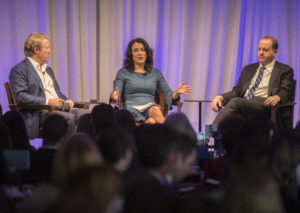
“I’m very proud to represent a business community that said it’s not just about us, it’s about our workers and the other sectors as much as it is about employers,” Brough said during a conversation with Gov. Jared Polis moderated by Kent Thiry – outgoing CEO of DaVita, which was the presenting sponsor of the event.
Polis agreed that more information on the impacts of such a program are needed: “I was very happy that the outcome allows the time and space to get something of that magnitude right,” he said.
Brough noted that the off-season would be spent working with legislators to build stronger partnerships with legislators.
Despite the challenges, there were wins for the business community in education. The Chamber supported several bills to expand educational attainment opportunities, from a pilot program to allow schools to create innovative learning plans that include more hands-on experiences, to making concurrent enrollment classes transferable at Colorado colleges and universities and offering credit for competencies gained from work-based learning.
But, the challenges remain in a state where 74 percent of the workforce needs a post-secondary credential – the highest education needs in the country. “We’re nowhere near where we should be,” Brough said. “We have to figure out how we close the gap because the pipeline is leaking right now.”
Governor shares reflections of first session
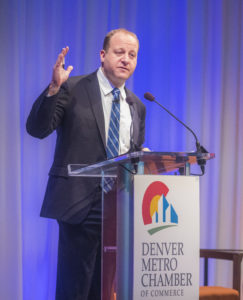
Polis shared his perspective on his first 120-day session with the audience of more than 700 metro area business leaders, noting, “We wasted no time in getting to work.”
He touted the passage of full-day kindergarten, which will start this fall; support for technology like blockchain in surprising industries such as agriculture; and the ballot referral of a question to voters to keep revenue in excess of the constitutional limitations of TABOR (the Taxpayer Bill of Rights). He also praised recent announcements of new jobs coming to the state from Checkr and Amazon.
“Come invest in Colorado!” Polis said.
Chamber turns attention towards ballot
Brough shared the Chamber’s support the TABOR De-Brucing ballot measure and expressed support for finding new streams of revenue to help fund the state’s water plan.
She also shared concerns about a measure in Lakewood that would cap growth in the city.
“Whether you are concerned about water, transportation, air quality or affordable housing, not allowing our state and our region to develop more densely is about the worst possible strategy we could employ,” Brough said.
Bill Lindsay Named Robert Blankenship Heart Award Honoree
Lindsay was recognized with the award, named in memory of Blankenship, the former chief operating officer of the Chamber and a steward of the business community.
Lindsay, principal of Lindsay3, has offered his time as a chair of the Chamber’s board of directors and has provided expertise and advocacy for small business and in navigating health care issues. Although Lindsay was unable to attend the event and accept the award in person, Children’s Hospital Colorado CEO Jena Hausmann read remarks on his behalf.
“I am especially honored and humbled to receive the Robert Blankenship Hear Award,” Hausmann read. “He was both my friend and my mentor, and thus to be the recipient of an award with his name on it is one of the most meaningful honors.”
The 2019 Colorado legislative session officially adjourned on Friday after a final week of all-night committee meetings, hearings and floor readings. It marked the close of a particularly challenging 120-day legislative session for the business community. At the end of the session, we found ourselves struggling to reconcile the fact that while we were successful in changing some particularly concerning bills, we were also exhausted and discouraged by what it took to get those changes.
We actually share many goals that our legislators wanted to achieve this session. We, too, want to:
What we learned was that despite these shared goals, we greatly differed in our approach regarding how we achieve them. And even though we so clearly shared a desired outcome, we had to fight hard for our perspective and solutions to be heard.
At the Denver Metro Chamber of Commerce, we recognize that opposing views are important and should be respected. We believe that listening to others helps mitigate the risk of unintended consequences and ensure we’re developing the best public policy solutions. We fundamentally believe that all three sectors – private, public and nonprofit – must be successful for Colorado to thrive.
But this session forcefully reminded us those values are not shared by some legislators. We found ourselves fighting to share our perspective on bills that could have devasted our employees and their employers. And we felt pitted against our partners in other sectors and even saw efforts create division between employers and their employees and between sectors.
We didn’t take the bait and neither did our partners; because of it, we did experience some success. Senate Bill 188, the FAMLI leave bill, which initially would have created a $1 - $2 billion employee leave program administered by the state and funded by a payroll tax, was amended into a study. This came after weeks of feedback from Colorado’s employers and employees that highlighted serious concerns about the financial solvency of such a large, new government program. Governor Polis heard those concerns and echoed them to legislators, who ultimately took steps to further amend the bill into a study. We’re grateful for the Governor’s leadership, legislative leadership and our Chamber members, who all voiced substantive concerns with the program. The study will provide the time and data to assess what segments of Colorado’s workforce aren’t receiving these types of benefits and how best to deliver them.
FAMLI wasn’t the only place we experienced success. We were able to amend bills that would have negatively impacted the business community such as bills on equal pay, consumer protection, penalties for failure to pay wages and on criminal history inquiries in a job application. We worked hard with legislators to ensure the business community was represented and employee and employer needs were met. And, we were able to help kill two bills of grave concern on the calendar – one that would have changed our Labor Peace Act and another to authorize rent control, which research shows wouldn’t positively impact the very people it aims to help.
But there were other bills that passed that we remain critically concerned about. House Bill 1261, which sets goals for greenhouse gas emissions reductions, did pass in the final moments of the session. We were opposed to this bill and will be requesting a veto from Governor Polis. To be clear, as we said earlier, the Chamber isn’t opposed to the notion of setting goals, but we are opposed to arbitrary goals that aren’t substantiated with research, and we strongly oppose the delegation of the very tough trade-off choices that must be made as part of this bill to the Colorado Air Quality Control Commission – an appointed, not elected, body – that doesn’t have the accountability to voters that the legislature does. All Coloradans will be impacted by policies aimed at addressing climate change, so we had hoped for amendments that would ensure Coloradans voices would be considered in developing the strategies by which these ambitious goals will be achieved.
Though the number of overall bills was slightly lower than recent sessions, this session had a higher risk of passage of harmful legislation and a greater degree and volume of amendments being sought than in recent years. That means many of these ideas had not been vetted and lacked the intellectual discipline Coloradans deserve when multi-billion-dollar ideas are being considered.
Our commitment remains as strong as ever to developing the trust necessary to ensure our member’s views are heard at the capitol for one reason – it’s the only way good policy can be made.
Kelly Brough is the president and CEO of the Denver Metro Chamber.
Read about our members in the news: CCIG and KLJ.
Our members work hard every day to make the Denver metro area a great place to do business. We want to keep you in the know about the important work of our members, whether they are opening new business locations, hiring more people or creating new partnerships.
John Kirke to Lead CCIG’s Employee Benefits Division
KLJ Hires Will Campbell, Joe Allison and Kirk Primavera
Read about our members in the news: Camp Run-A-Mutt Entrepreneurial Resources.
Our members work hard every day to make the Denver metro area a great place to do business. We want to keep you in the know about the important work of our members, whether they are opening new business locations, hiring more people or creating new partnerships.
Camp Run-A-Mutt Entrepreneurial Resources is Excited to Announce the Opening of the First Denver Location of Camp Run-A-Mutt Cage-Free Doggie Day Care and Boarding